
ASTRA: Book One
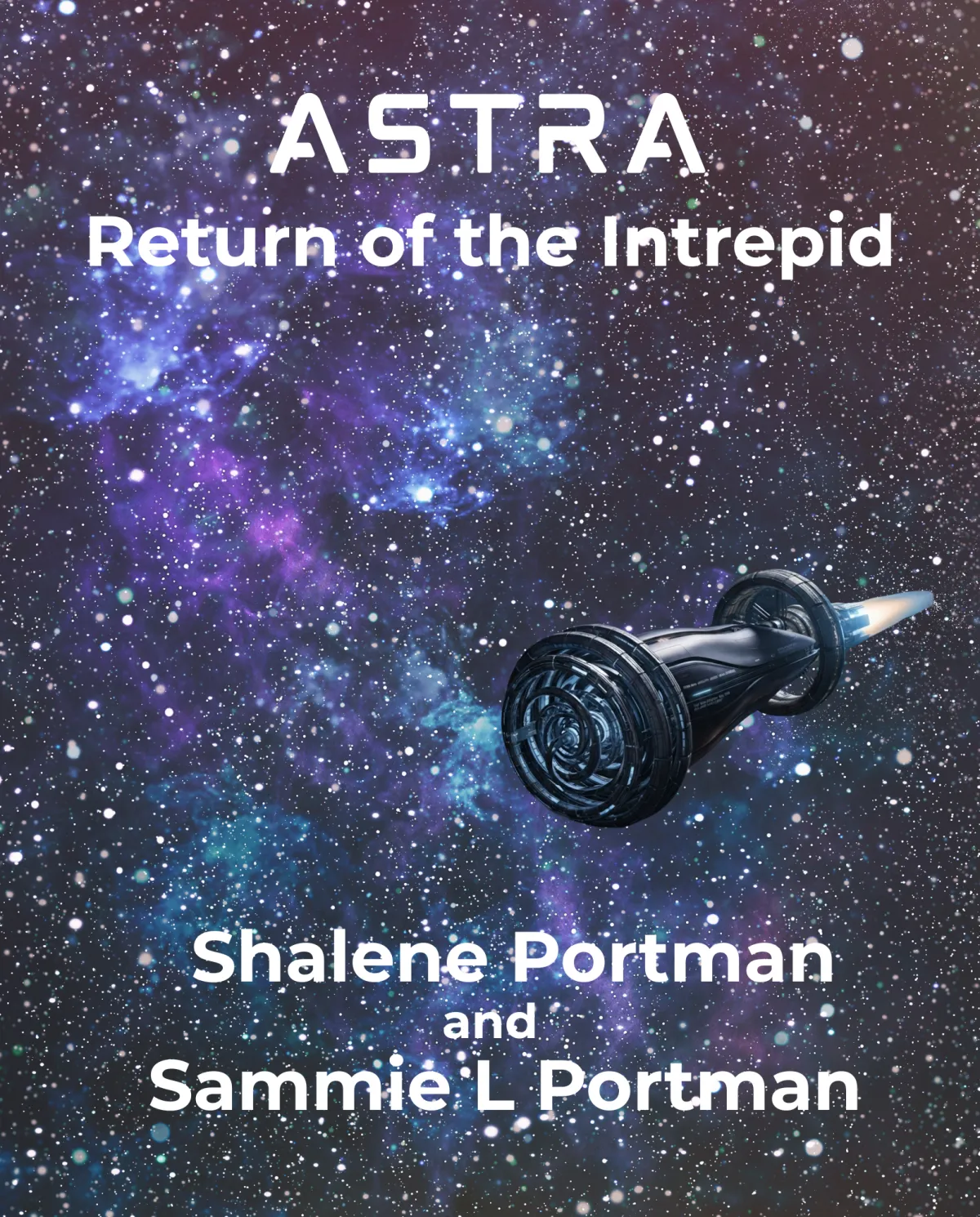
Return of the Intrepid
The first in the exciting new series, ASTRA.
Sammie L Portman & Shalene Portman
After years of starship command, Zalisae St. James believed becoming an admiral was the natural next step. Instead, she found herself trapped behind reports and politics, far from the bridge and the stars she loved. Then the impossible happens.
The USSF Intrepid, a Space Force Class E long range cruiser lost years earlier in a mysterious interdimensional event, reappeared and is moving through space under unknown control. With shields raised, weapons ready, and on a course toward the Solar System through a dangerous frontier region bordering hostile space, it's set to wreak havoc if not start an intergalactic war.
ASTRA must move quickly to intercept the ship and determine if it's friend or foe. Can they salvage the ship or will they have to destroy it and whatever life form is controlling it?
Officially, this is a recovery mission, but for St. James, it is a chance to solve a mystery that has haunted her for years—and perhaps get her back in the command chair she wishes she'd never given up.
Sneak Preview!
The Story Behind ASTRA
In the 1970s, my mother wrote a full-length Star Trek novel titled The Return of the Defiant. It was submitted for publication but ultimately rejected, and the manuscript—along with the rejection letters—was packed away and forgotten. Years after she passed away, I found it.
Curious, I sat down to read it and discovered that the story had real merit. Rather than let it sit in a box, I decided to give it a second life. There was just one problem: to publish it, every trace of Star Trek had to go.
What I thought would be a simple rewrite quickly became the creation of an entirely new universe. I suppose I could have just made up a bunch of folderol, but where's the fun in that? To replace the Federation I created ASTRA- Aerospace Strategic Tactical Response Alliance. Replacing Starfleet meant developing a new military organization- but I am enamored of our newborn US Space Force, and I so I kept it with a vision this is what it will look like in a few hundred years. I also had to create new alien civilizations with their own history, ships, bases, planets- everything from scratch.
I wanted it to be based on real science, so I spent countless hours researching astronomy, planetary science, and emerging technologies, grounding the new universe in real science wherever possible. Many of ASTRA's worlds are based on actual stars, planets, and moons that scientists believe could one day support human life. I am not a scientist, but I did really try to keep this grounded in science.
Admiral James T Kirk became a female, Admiral Zalisae (pronounced ZAL-ih-say) St. James (yes, James is a nod to the original Kirk character) and all the others changed too, as well as their history. One thing that didn't change, is that overall feeling of camaraderie, curiosity and sheer grit to explore and conquer space. I also tried to keep my mother's writing as much as possible, so this is really a collaboration, post humous.
I am giving my mother co writing credit for Return of the Intrepid because she wrote the original manuscript and because I know she'd be tickled pink that a book was published with her name on it, but going forward, I will be the sole author writing the future of Zalisae St. James and her adventures.
Here's to you, Mom. I know you loved Star Trek, but hopefully you look down from the stars and approve of ASTRA and where I'm going with your story!
Prologue
Humanity reached for the stars not because of war, but because Earth could no longer contain its dreams.
The foundation was laid in 2019 with the formal establishment of the United States Space Force. Initially tasked with securing our orbital infrastructure, the USSF soon found that the frontier demanded more than just monitoring—it demanded presence. As private industry and NASA-led missions secured a foothold on the Moon, mining the water ice that would become the lifeblood of our expansion, the USSF evolved.
By the time the first permanent settlements hummed across the red plains of Mars, the USSF had transformed into something entirely new. It became a true space-faring Navy—a deep-space vanguard tasked not only with security but with the charting and protection of humanity’s reach. They pushed into the void, mapping the moons of Jupiter and Saturn, providing the logistical backbone for a growing civilization, and ensuring the lanes of commerce remained open to the furthest outposts of human ingenuity.
It was as we reached past our solar system and stepped onto the galactic stage that we got noticed.
At first, the signs were easy to dismiss. Automated stations went dark, and deep-space sensors recorded anomalies that defied known physics. Then came the attacks—coordinated, ruthless strikes that ignored the borders and politics of Earth.
In 2255, the reality of our vulnerability forced a final, inevitable shift. While every major nation—including the United States—maintained its own sovereign Space Force, the need for a unified front became absolute. The spirit of the Artemis Accords was hardened into a pact of mutual defense, giving birth to the Aerospace Strategic Tactical Response Alliance—ASTRA.
Modeled after the naval alliances that once kept the seas of Earth secure, ASTRA became the unified shield of humanity. Within this structure, the USSF acted as the primary pillar, contributing a fleet of long-range cruisers like the Intrepid—vessels built for the hard realities of the deep frontier. Its mission was clear: an attack on one colony was an attack on all.
Chapter One
Coming Soon
Buy it on Amazon
Coming soon!
E-Book
Coming soon!
Audio Book
Coming Soon
Want to know more?
Join the Bits of Wit Book Club
It's FREE and we'll send you updates on new releases, author updates and free perks like audio books or downloadable pages.
Join the Bits of Wit Book Club!
It's FREE and we'll send you updates on new releases, author updates and free perks like audio books or downloadable pages.


